
Die Cut vs. Moulded Rubber Gaskets: Which Is Right for Your Project?
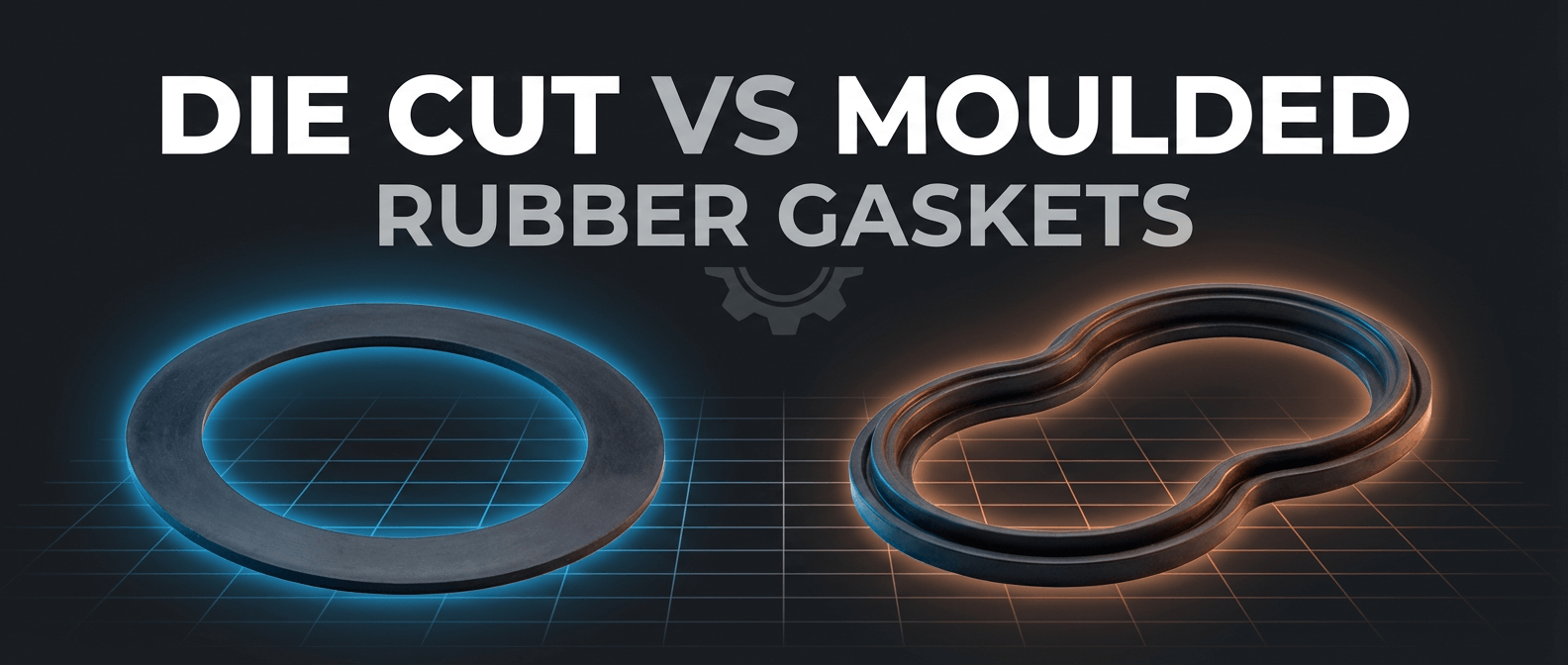
Selecting the right gasket manufacturing method is just as important as choosing the right material. When designing sealing solutions, engineers often evaluate two common options: die cut rubber gaskets and moulded rubber gaskets. Both offer reliable sealing performance, but their suitability depends on design complexity, production volume, pressure requirements, and application environment.
What Are Die Cut Rubber Gaskets?
Die cut gaskets are produced by cutting gasket shapes from rubber sheets using precision dies. This method is ideal for flat gasket designs with consistent thickness.
Advantages of Die Cut Gaskets
- Cost effective for low to medium production volumes
- Quick turnaround time
- Suitable for simple and flat profiles
- Ideal for prototyping and short runs
Limitations
- Limited to sheet thickness availability
- Not suitable for complex 3D geometries
- Lower performance in high-pressure dynamic applications
What Are Moulded Rubber Gaskets?
Moulded gaskets are manufactured through compression or injection moulding, where rubber is shaped within a custom tool to achieve precise dimensions and complex geometries.
Advantages of Moulded Gaskets
- Suitable for intricate and custom designs
- Superior dimensional accuracy
- Better performance in high pressure applications
- Integrated features like grooves or sealing lips
Limitations
- Higher tooling cost
- Longer development time
- More economical for medium to high production volumes
Key Differences at a Glance
| PARAMETER | DIE CUT GASKETS | MOULDED GASKETS |
|---|---|---|
|
TOOLING INVESTMENT |
LOW |
MODERATE TO HIGH |
|
DESIGN FLEXIBILITY |
LIMITED TO FLAT SHAPES |
COMPLEX 3D DESIGNS POSSIBLE |
|
DIMENSIONAL PRECISION |
MODERATE |
HIGH REPEATABILITY |
|
VOLUME SUSTAINBILITY |
LOW-MEDIUM |
MEDIUM-HIGH |
|
PERFORMANCE IN CRITICAL APPLICATIONS |
MODERATE |
EXCELLENT |
Die Cut Rubber Gaskets for OEM Applications
Die cut gaskets are manufactured by precision cutting rubber sheets into required profiles. They are ideal for flat, two dimensional sealing designs.
Best for OEMs when
- The gasket profile is flat and simple
- Rapid prototyping is required
- Production volumes are low to moderate
- Tooling investment needs to be minimal
- Static sealing applications are involved
Typical OEM Applications
- Electrical enclosures
- HVAC systems
- Panel sealing
- Light duty flange connections
Die cutting offers shorter development cycles and cost efficiency, making it suitable during early stage product development or limited production runs. However, dimensional tolerances are limited by sheet variation, and the method is not suitable for complex geometries or high pressure dynamic applications.
Moulded Rubber Gaskets for OEM Applications
Moulded gaskets are produced using compression or injection moulding processes with dedicated tooling. This method allows for precise geometry, integrated sealing features, and consistent dimensional control.
Best for OEMs when
- The design includes grooves, lips, ribs, or 3D profiles
- Tight tolerances are critical
- The application involves high pressure or temperature
- Medium to high production volumes are planned
- Long term durability and repeatability are essential
Typical OEM Applications
- Pump and valve assemblies
- Automotive systems
- Oil & gas equipment
- Chemical processing machinery
Although tooling costs are higher initially, moulded rubber gaskets offer superior repeatability, structural integrity, and performance consistency, crucial for OEM supply chains.
Which Gasket Is Right for Your Application?
Choose die cut rubber gaskets if:
- Your design is flat and simple
- You need quick production
- Budget constraints are important
- You are in the prototyping stage
Choose moulded rubber gaskets if:
- The design requires custom geometry
- The application involves high pressure or temperature
- Long-term durability is critical
- You need integrated sealing features
-
Facebook
-
Linkedin
-
Youtube

Recent Blogs
Our Case Study
-
Reducing Downtime in Water Treatment Systems with Precision Rubber Gaskets
-
PTFE Bonded Diaphragm Solution for High Temperature Industrial Pumps
-
How a Custom Rubber Diaphragm Improved Pump Efficiency
-
Stators Manufactured for a Screw Pump Manufacturer
-
Diaphragms Designed and Manufactured for a Valve Manufacturer