
Failure Analysis of Rubber Diaphragms: Identifying Root Causes in Industrial Systems
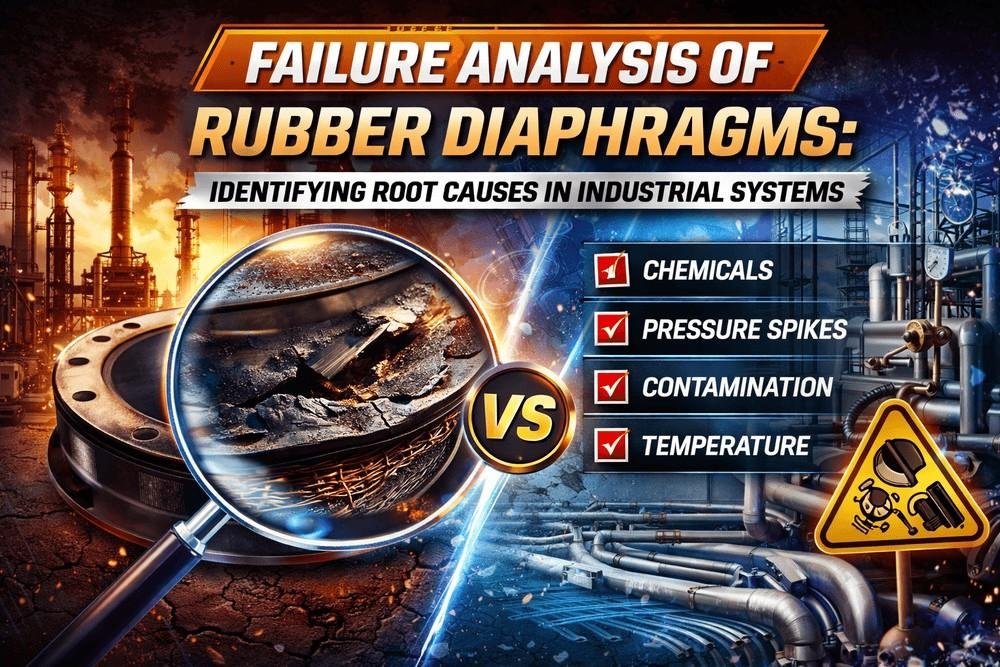
Rubber diaphragms are critical components used in valves, pumps, and actuators for sealing and pressure control. Failure of these diaphragms can lead to leakage, system inefficiency, and costly downtime. A structured failure analysis helps identify root causes and improve performance.
Common Failure Modes
- Cracking / Hardening
Caused by heat, ozone exposure, or aging - Tearing / Rupture
Due to overpressure, fatigue, or improper installation - Swelling / Softening
Result of chemical incompatibility - Delamination (Reinforced Diaphragms)
Separation of layers under cyclic stress
- Cracking / Hardening
Major Root Causes
a. Incorrect Material Selection
- Elastomer not suitable for media or temperature
- Leads to premature degradation
b. Excessive Mechanical Stress
- Pressure beyond design limits
- Frequent pressure spikes
c. Improper Installation
- Uneven tightening or misalignment
- Creates localized stress points
d. Thermal Degradation
- Continuous exposure to high temperatures
- Loss of elasticity over time
e. Chemical Attack
- Aggressive fluids damaging polymer structure
- Swelling or embrittlement
f. Manufacturing Defects
- Poor curing or weak bonding
- Internal voids or reinforcement failure
3. Failure Analysis Process
- Visual Inspection – cracks, wear, deformation
- Physical Testing – hardness, tensile strength
- Chemical Analysis – media compatibility
- Microscopic Examination – internal defects
- Application Review – actual vs design conditions
4. Key Warning Signs
- Leakage or pressure drop
- Reduced flexibility
- Surface swelling or stickiness
- Uneven wear patterns
5. Preventive Measures
- Select application-specific elastomers
- Operate within pressure & temperature limits
- Ensure correct installation practices
- Conduct regular inspection & maintenance
- Partner with experienced manufacturers
Internal Link: Discover our Custom Rubber Diaphragm Solutions
Most rubber diaphragm failures are preventable. The root cause typically lies in material mismatch, incorrect operating conditions, or installation errors. A systematic failure analysis not only solves issues but enhances long-term system reliability.


[wp_comments]
Recent Blogs
Our Case Study
-
Reducing Maintenance Downtime with High Performance Rubber Diaphragms
-
Eliminating Repeated Seal Failures Through Design & Compound Optimization
-
How Material Selection Improved O-Ring Performance in High Temperature Applications
-
PTFE Bonded Diaphragm Performance Improvement in High Temperature Valve Systems
-
Supplying Rubber & PTFE Components for Chemical Processing Plants in Europe