
Machining Challenges in PTFE Components and How Manufacturers Overcome Them
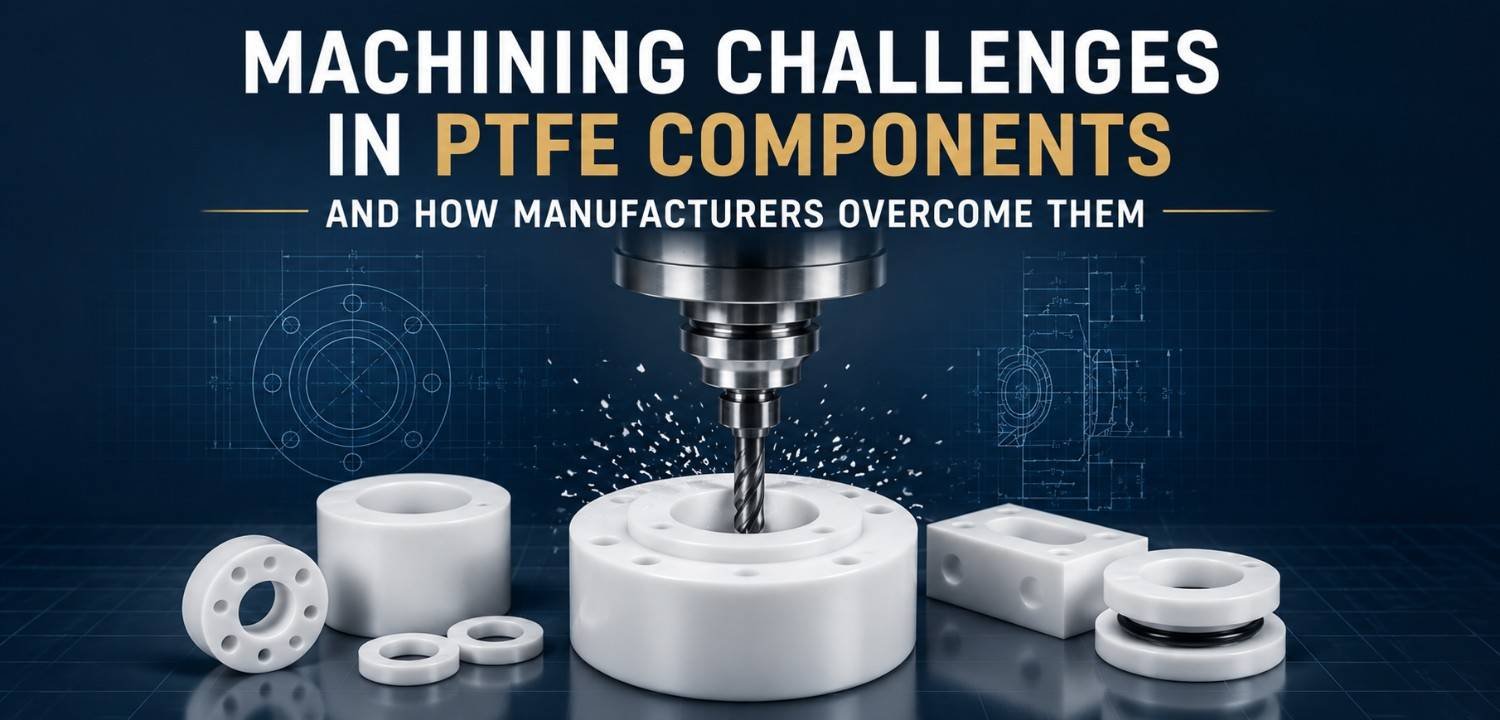
PTFE is widely used in industrial applications due to its excellent chemical resistance, low friction, and high temperature stability. However, machining PTFE components comes with unique challenges that differ significantly from conventional engineering plastics or metals.
Achieving dimensional accuracy and consistent performance requires specialized machining techniques and process control.
Why PTFE Is Difficult to Machine
PTFE is soft, flexible, and highly sensitive to deformation. Unlike rigid materials, it tends to react differently during cutting and finishing operations.
Common machining challenges:
- Material deformation during machining
- Dimensional instability
- Thermal expansion issues
- Burr formation and poor edge finish
- Difficulty maintaining tight tolerances
These factors make precision machining more complex.
1. Material Deformation
PTFE has a low modulus and can easily deform under machining pressure.
This can result in:
- Inaccurate dimensions
- Ovality in turned components
- Surface inconsistencies
How manufacturers overcome it:
- Using sharp cutting tools with optimized geometry
- Applying controlled cutting pressure
- Supporting components properly during machining
2. Thermal Expansion & Heat Build-Up
PTFE has a high volume of thermal expansion. Even slight temperature changes can affect dimensions.
Challenges include:
- Expansion during machining
- Difficulty achieving tight tolerances
- Dimensional variation after cooling
Solutions:
- Maintaining controlled machining temperatures
- Allowing material stabilization before final machining
- Using proper machining speeds and feeds
3. Maintaining Tight Tolerances
PTFE’s flexibility makes precision tolerances difficult, especially in thin wall or complex components.
This becomes critical in:
- Rubber Seals
- Valve seats
- Bushings
- Precision industrial parts
Manufacturer approach:
- Multi stage machining processes
- Intermediate stress relief cycles
- Precision inspection at multiple stages
4. Burr Formation & Surface Finish Issues
PTFE can produce burrs or uneven edges during machining due to its softness. Poor surface finish may affect sealing performance and fitment.
How it is controlled:
- High-precision tooling
- Fine finishing operations
- Skilled handling during post processing
5. Challenges in Filled PTFE Grades
Filled PTFE grades such as glass filled or bronze filled PTFE introduce additional machining complexity.
- Glass filled PTFE = abrasive to tools
- Bronze filled PTFE = higher cutting resistance
- Carbon filled PTFE = requires optimized tooling parameters
Manufacturers often use specialized tooling and adjusted machining conditions for each grade.
Importance of Process Control
Consistent PTFE component quality depends heavily on process control.
Key focus areas:
- Tool selection
- Cutting parameters
- Temperature control
- Material conditioning
- Final inspection and dimensional verification
A controlled machining process ensures reliable component performance in critical applications.
Machining PTFE components requires expertise, precision, and process optimization. From dimensional instability to thermal expansion challenges, manufacturers must carefully control every stage of production. With the right machining approach and quality controls, PTFE components can deliver exceptional performance across demanding industrial applications.