
NBR Rubber: Properties, Uses & When to Choose It
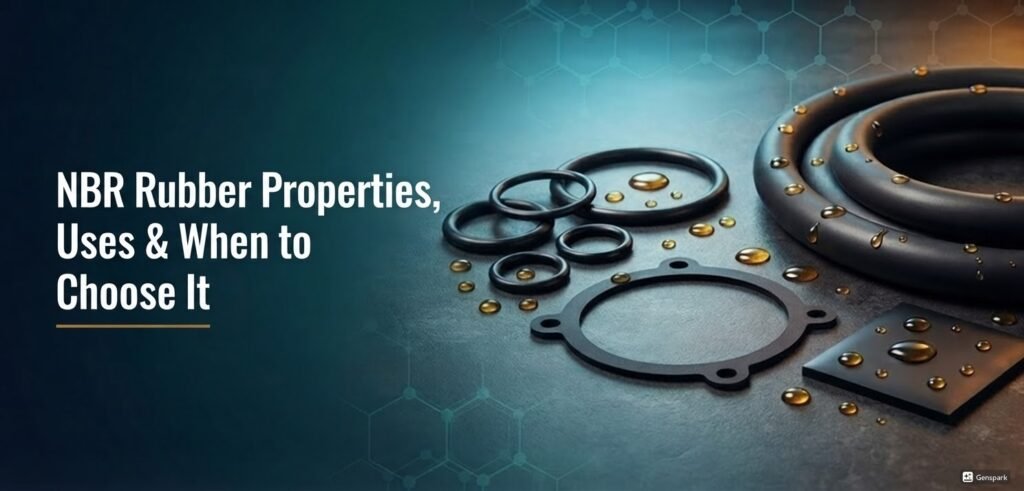
Nitrile Butadiene Rubber (NBR), commonly known as Nitrile Rubber, is a synthetic elastomer widely used in industrial sealing applications. Its excellent resistance to oils, fuels, and greases makers it a preferred material for components exposed to petroleum based fluids.
NBR is commonly used in O-rings, gaskets, seals diaphragms, and other industrial rubber components where reliable sealing and mechanical durability are essential.
Key Properties of NBR Rubber
NBR rubber offers a combination of oil resistance, mechanical strength, and wear resistance. Its performance depends on the compound formulation and acrylonitrile (ACN) content.
Key NBR rubber properties include:
- Oil and fuel resistance: Performs well in applications involving mineral oils, lubricants, fuels, and greases.
- Mechanical strength: Offers good tensile strength and durability for industrial applications.
- Abrasion resistance: Suitable for components exposed to friction and repeated movement.
- Customizable flexibility: Different grades balance oil resistance and low temperature flexibility.
- Temperature resistance: Standard NBR compounds typically operate around –30°C to +100°C, depending on the formulation.
However, NBR has limited resistance to ozone, UV exposure, weathering, and certain aggressive chemicals, including ketones and aromatic solvents.
Common Applications of NBR Rubber
NBR is widely used across industries where oil resistance and dependable sealing are important.
Common applications include:
- Automotive: Fuel hoses, oil seals, gaskets, and engine components.
- Pumps and valves: O-rings, valve seals, and sealing components.
- Hydraulic systems: Hydraulic seals, packings, and oil resistant components.
- Industrial machinery: Rubber gaskets, moulded parts, and oil resistant seals.
- Fluid handling: Components exposed to lubricants, fuels, and selected industrial fluids.
When Should You Choose NBR Rubber?
NBR is a suitable choice when an application requires:
- Resistance to petroleum-based oils, fuels, and greases.
- Reliable sealing under moderate operating temperatures.
- Good abrasion resistance and mechanical durability.
- A practical, cost-effective material for industrial components.
For applications involving prolonged outdoor exposure, high temperatures, or aggressive chemicals, alternatives such as EPDM, HNBR, or FKM may be more appropriate, depending on the operating conditions. NBR rubber is a versatile material for oil-resistant industrial sealing applications. Selecting the right NBR compound requires evaluating fluid compatibility, temperature, pressure, and operating conditions to achieve dependable performance and service life.