
Traceability in Rubber Manufacturing: Why It Matters for Export Clients
In today’s global manufacturing environment, product quality alone is no longer enough. Export clients increasingly expect complete traceability throughout the manufacturing process to ensure consistency, compliance, and accountability. For industrial rubber components such as diaphragms, gaskets, O-rings, stators, and molded parts, traceability plays a critical role in maintaining quality standards and building customer confidence.
What is Traceability in Rubber Manufacturing?
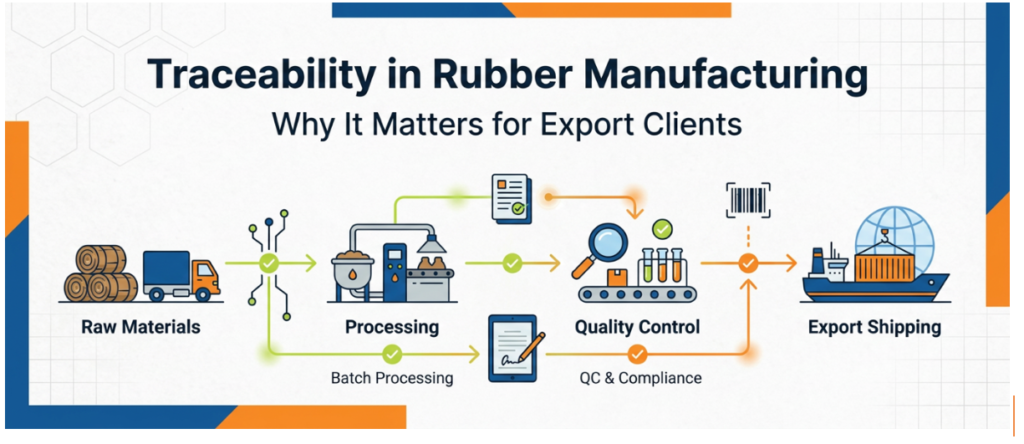
Traceability refers to the ability to track a product throughout its manufacturing lifecycle from raw material procurement to final dispatch.
A robust traceability system allows manufacturers to identify:
- Raw material batches used
- Production dates
- Machine and process records
- Inspection and testing results
- Final shipment details
This creates a documented history for every component produced.
Why Export Clients Prioritize Traceability
Many international customers operate in highly regulated industries where quality documentation is essential.
Traceability helps rubber components export clients by providing:
- Greater confidence in product quality
- Faster resolution of quality concerns
- Improved supply chain transparency
- Compliance with customer and industry requirements
- Reduced operational risk
For OEMs and industrial buyers, traceability is often viewed as a key supplier qualification criterion.
Key Areas of Traceability in Rubber Manufacturing
Raw Material Control
Every production batch should be linked to specific raw material lots.
This helps verify:
- Compound consistency
- Material specifications
- Supplier records
Production Tracking
Maintaining records of manufacturing parameters allows better process control.
Typical records include:
- Batch numbers
- Production dates
- Machine identification
- Operator details
Inspection & Quality Records
Inspection reports provide evidence that products meet specified requirements.
Common quality checks include:
- Dimensional inspection
- Hardness testing
- Visual inspection
- Performance testing
Shipment Traceability
Finished products should remain traceable even after dispatch.
Proper labelling and documentation help customers identify:
- Manufacturing batch
- Production history
- Quality records
Benefits for Manufacturers and Customers
An effective traceability system offers advantages beyond compliance.
Benefits include:
- Faster root cause analysis
- Improved quality consistency
- Reduced rejection rates
- Better corrective action management
- Increased customer trust
For export markets, these advantages can strengthen long-term business relationships.
Traceability has become an essential part of modern rubber manufacturing. For export clients, it provides confidence that products are manufactured consistently, tested thoroughly, and supported by documented quality records.
Arvico Rubber Industries invests in strong traceability systems that are better positioned to meet international expectations, improve quality control, and build lasting partnerships with global customers.