
Reinforced vs Fabric Backed Rubber Diaphragms: Performance & Use Cases
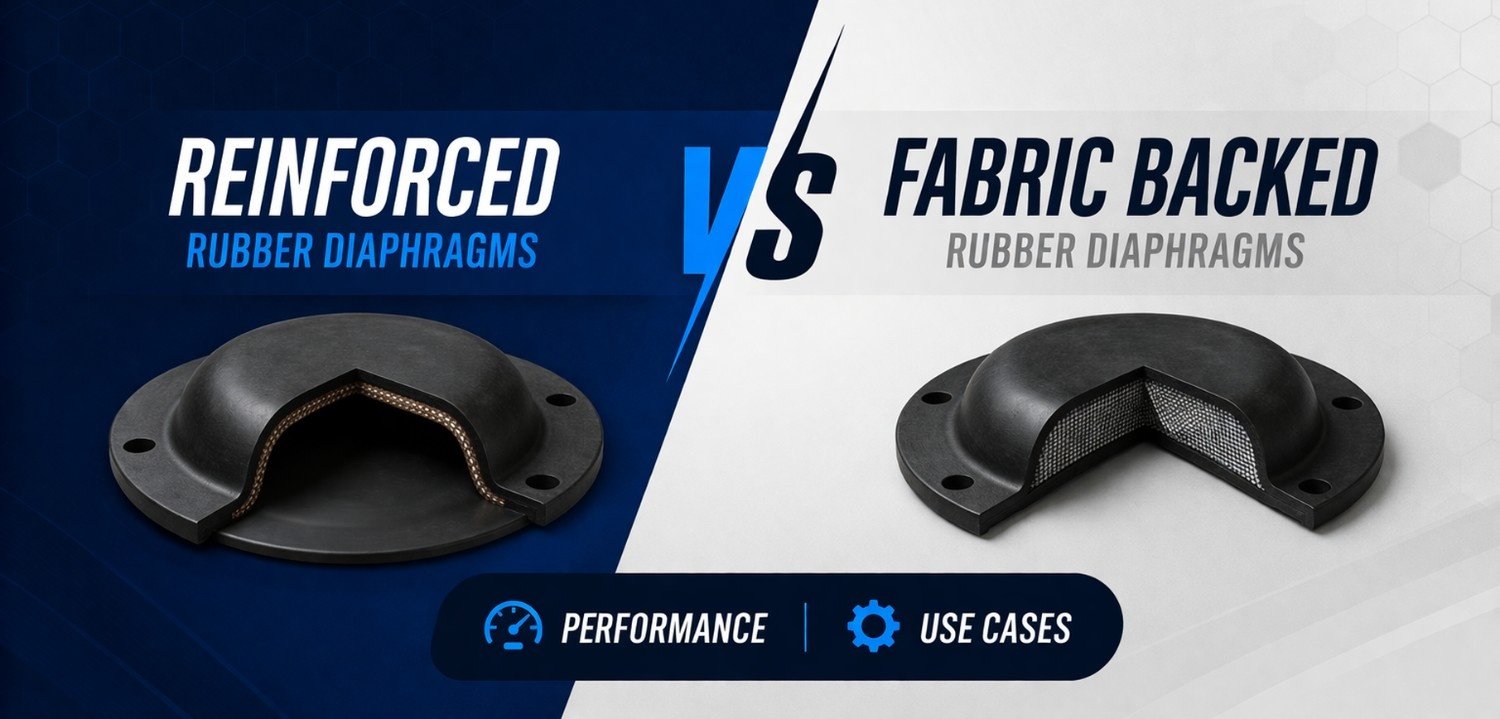
In industrial sealing applications, rubber diaphragms play a critical role in ensuring reliable pressure control, flexibility, and durability. However, not all diaphragms are built the same. For demanding applications, manufacturers often choose between reinforced rubber diaphragms and fabric-backed diaphragms, each designed to enhance performance under specific operating conditions.
Understanding the differences between these two types is essential for OEMs and engineers looking to optimise performance and service life.
What Are Reinforced Rubber Diaphragms?
Reinforced rubber diaphragms are designed with an additional strengthening layer embedded within the rubber structure. This reinforcement is often made from synthetic fabric or mesh improves the diaphragm’s mechanical strength, dimensional stability, and resistance to deformation.
Key Benefits
- Higher resistance to pressure and stress
- Reduced risk of ballooning or distortion
- Improved durability in cyclic operations
- Enhanced performance in high load environments
These diaphragms are widely used in pumps, valves, actuators and control systems where consistent performance under pressure is critical.
What Are Fabric Backed Rubber Diaphragms?
Fabric backed diaphragms feature a fabric layer bonded to one side of the rubber. Unlike fully reinforced diaphragms, this design primarily enhances flexibility control and directional strength rather than overall structural reinforcement.
Key Benefits
- Controlled flexibility and movement
- Improved tear resistance
- Better shape retention during repeated cycles
- Cost effective for moderate duty applications
They are commonly used in low to medium pressure systems, including pneumatic devices and lightweight valve assemblies.
| Feature | Reinforced Diaphragms | Fabric Backed Diaphragm |
|---|---|---|
|
Structure |
Embedded reinforcement layer |
Fabric layer on one side |
|
Pressure Handling |
High |
Moderate |
|
Flexibility |
Moderate |
High (controlled) |
|
Durability |
Excellent for heavy duty use |
Suitable for lighter cycles |
|
Typical Applications |
Pumps, Valves, Industrial Systems |
Pneumatic and low pressure systems |
Choosing the Right Diaphragm
The selection between reinforced and fabric backed diaphragms depends on several key factors
- Operating pressure and load conditions
- Frequency of actuation cycles
- Required flexibility vs strength
- Application environment (chemical, temperature exposure)
For high pressure, high cycle industrial applications, reinforced diaphragms offer superior reliability and longer service life. On the other hand, fabric backed diaphragms provide a cost effective solution where flexibility and moderate performance are sufficient.


Recent Blogs
Our Case Study
-
Reducing Maintenance Downtime with High Performance Rubber Diaphragms
-
Eliminating Repeated Seal Failures Through Design & Compound Optimization
-
How Material Selection Improved O-Ring Performance in High Temperature Applications
-
PTFE Bonded Diaphragm Performance Improvement in High Temperature Valve Systems
-
Supplying Rubber & PTFE Components for Chemical Processing Plants in Europe