
Surface Finish and Flange Alignment: Hidden Factors in Gasket Sealing Performance
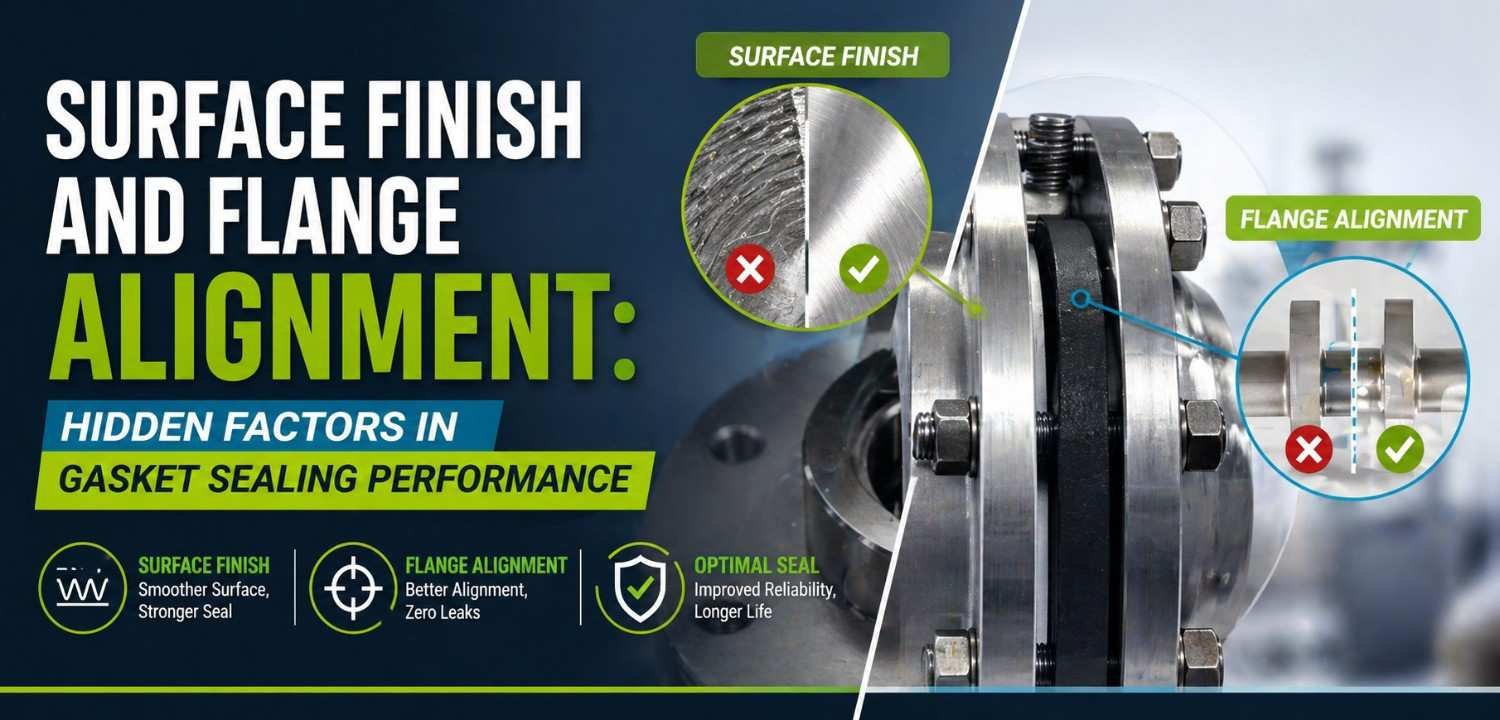
Gasket failures are often blamed on material selection or pressure conditions. However, two critical yet overlooked factors surface finish and flange alignment play a major role in sealing performance.
Even the best rubber gasket can fail if the mating surfaces and assembly conditions are not properly controlled.
Why Surface Finish Matters
Surface finish refers to the roughness or smoothness of the flange face where the gasket sits. It directly impacts how well the gasket can conform and seal.
A balanced surface profile is essential:
- Too rough:
- Creates leak paths through deep grooves
- Requires higher compression to seal effectively
- Too smooth:
- Reduces friction, increasing risk of gasket slippage
- Limits the gasket’s ability to “grip” the surface
For optimal sealing, a controlled surface finish allows the gasket to deform slightly and fill micro irregularities, ensuring a tight seal.
Impact of Flange Alignment
Gasket flange alignment is equally critical but often neglected during installation. Misalignment introduces uneven stress across the gasket surface, leading to localized failure.
Common alignment issues include:
- Angular misalignment (tilted flanges)
- Parallel misalignment (offset faces)
- Uneven bolt tightening
These issues result in:
- Uneven compression across the gasket
- Overloading in certain areas → crushing or extrusion
- Under-compression in other areas → leakage
Combined Effect on Sealing Performance
When poor surface finish and misalignment occur together, the risk of failure increases significantly.
- Irregular surfaces + uneven load = incomplete sealing
- Increased chances of leakage under pressure
- Reduced gasket life and frequent replacements
Even high performance materials cannot compensate for poor installation conditions.
Best Practices for Reliable Sealing
To ensure consistent gasket performance:
- Maintain recommended flange surface finish standards
- Inspect flange faces for damage, corrosion, or irregularities
- Ensure proper flange alignment before installation
- Follow correct bolt tightening sequence and torque values
- Avoid over compression or uneven loading
A well installed gasket on properly prepared surfaces can significantly improve sealing efficiency and lifespan.
Surface finish and flange alignment are often hidden but critical factors in gasket sealing performance. Ignoring them can lead to premature failures, leakage, and increased maintenance costs. Focusing on these fundamentals ensures better sealing reliability, longer gasket life, and improved system performance.


Recent Blogs
Our Case Study
-
Reducing Maintenance Downtime with High Performance Rubber Diaphragms
-
Eliminating Repeated Seal Failures Through Design & Compound Optimization
-
How Material Selection Improved O-Ring Performance in High Temperature Applications
-
PTFE Bonded Diaphragm Performance Improvement in High Temperature Valve Systems
-
Supplying Rubber & PTFE Components for Chemical Processing Plants in Europe